EDUCATIONAL ROLE OF LANGUAGE JOURNAL - MISSION & SCOPE
AIMS
ERL JOURNAL aims to publish papers on issues lying at the intersection of linguistic and educational studies. The journal’s inception has been prompted by our shared aspiration to study and boost the position of language in education. Its key aim follows from the so-called ‘linguistic turn’, whereby how people learn and how they see the surrounding world is strongly determined by language. This implies that language underlies and binds education, meriting a special place in educational studies.
ERL JOURNAL’s area of interest comprises ‘Scope Major’ and ‘Scope Minor’. The former, broader, covers studies of the educational role of language at the level of school, culture, methods and personality. The latter, narrower, is learner-focused and covers studies pertaining to language in four educational domains: language-beliefs (what learners THINK OF language), language-activity (what learners can DO WITH language), language-affect (how learners FEEL ABOUT language), and language-thinking (how learners UNDERSTAND THROUGH language). The issues addressed in papers are diversified yet complementary to one another within and across the two aforementioned scopes.
ERL JOURNAL accepts papers addressing language and education jointly (as opposed to those which pertain to either language or education only). We welcome theoretical and/or empirical papers, presenting the aforementioned issues from a qualitative or quantitative perspective, or both. We are particularly keen to publish papers reporting on international studies, the focus of which can be clearly defined as falling within the ‘Scope Major’ or ‘Scope Minor’, or those which aspire to study issues at their intersections. Papers can relate to L1, L2/FL, or both.
ERL JOURNAL, as follows from the above, assumes an interdisciplinary approach. Accordingly, we shall be ready to publish papers authored by, for instance, sociolinguists, psycholinguists, applied linguists, linguistic anthropologists, theoreticians of education, experts of developmental psychology, comparative or cultural linguistics experts, cognitive scientists, and specialists of many other subdisciplines, whose considerations and findings might widen our awareness of how language operates in education across various subjects.
SCOPE MAJOR
Key premise. The educational role of language, reaching far beyond school(ing), is determined by multiple aspects relating to culture, methodology and/or personality. To be suitably comprehensive, studies blending educational with linguistic studies need to comprise all these aspects.
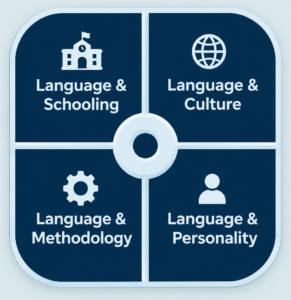
General rationale. Language lies at the heart of schooling, culture, (learning and teaching) methods, and personality – thus underlying education on the individual and on the social level. Its social existence determines its experiencing by an individual person and vice versa. Both these levels matter when it comes to learning and teaching methods as well as schooling as a whole. Socially determined and individually experienced, language shapes culture and education, and, from an individual perspective, it defines a person’s place in the world and defines the world in which a person is placed.
Specific issues. Accordingly, ERL Journal welcomes papers addressing issues such as: language of schooling, bilingual education, language identity, intercultural competence, discourse analysis, children narratives, personal constructs, language in special education, transversal skills, language mediation, academic language, elicitation, plurilingual teaching, CLIL, functions of language, etc.
Expected outcome. Systematization of knowledge concerning the educational position of language; aggregation of empirical findings pertaining to social and cultural determinants of how language serves education; development of interdisciplinary educational and linguistic studies; recognition of problems calling for research and discussion of ways of putting language theories into practice.
SCOPE MINOR
Key premise. A person’s education is determined by how language operates on four levels – beliefs, activity, affect and thinking. To be maximally educational, the experiencing of language by a person comprises these four dimensions, which implies a need for their comprehensive studies.

General rationale. How language affects a person’s education depends on multiple axiological, psychomotor, affective, and cognitive factors. For instance, what a person thinks of language (e.g. on whether it is worth speaking or not) and how much a person speaks determines that person’s mental faculties. Conversely, how a person understands a given issue (as well as how s/he feels about it) impacts on how interesting utterances s/he produces. Hence, there exist relationships between language and all the aforementioned educational domains.
Specific issues. Accordingly, ERL Journal welcomes papers concerning issues falling within one or more of the four domains, such as: status of language in school curricula, language of textbooks, language activity of children or grown-ups, stages of language fossilization, argumentative skills, language learning styles, verbalization of knowledge, approaches to oracy, personal experiencing of language skills, language image of the world, cognitive discourse functions, language reflectivity, etc.
Expected outcome. Collection of theoretical proposals and empirical data supporting learner-oriented educational practice; exploration of the relationship between language and four educational domains; detection of factors determining learners’ language identity/personality; accumulation of data providing assistance in construction of language-grounded educational systems.