ERL JOURNAL KEY DATA & 10 QUALITY BENCHMARKS
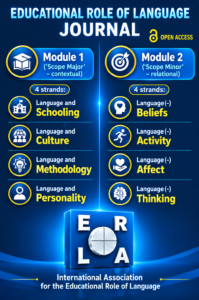
short name: ERL Journal; founded in 2018
peer-reviewed, double-blinded, biannual
ISSN: 2657-9774 DOI prefix:10.36534
free-of-charge publications
Publisher:
International Association for the Educational Role of Language
Homepage:
educationalroleoflanguage.org/erl-journal
Email:
journal@educationalroleoflanguage.org
The journal was created to fill the niche and to study the key position of language in education.
Since its very first volume, ERL Journal has striven to meet the following 10 quality benchmarks:
1.
NOVEL CHARACTER
a unique platform for empirical and theoretical papers addressing the linguistic dimension of all education and placing language in the very centre of education
2.
EXTENSIVE INTERNATIONALISATION
geographical diversity on different levels, including the authors, reviews, affiliations of the editorial board, strand coordinators, advisory board
3.
EASY ACCESS
ready availability of all the papers, reviews and reports published in all the volumes, with the possibility of downloading any given text from any issue
4.
CONSISTENT TRAJECTORY
following the path developed jointly by ERLa and outlined online as well as in the introductions to the subsequent issues of the journal
5.
GLOBAL RECOGNITION
growing presence in journal databases, libraries, search engines, incl. EBSCO Host, ERIH Plus, DRJI, ROAD, Index Copernicus International, and many more
6.
READER FRIENDLINESS
content easily found thanks to application of different criteria (incl. alphabetical listing of all titles published, coloured index of things)
7.
AUTHOR FRIENDLINESS
availability of ready-given (paper/report/review) templates with additional advice provided on the structure, simplicity of text construction guidelines
8.
REGULAR PUBLICATIONS
two issues being published every year and being immediately available online without any restrictions in downloading
9.
SPECIAL ISSUES
the possibility of publishing issues intersecting or reaching beyond the journal’s key strands, with guest editors being most welcome
10.
METHODOLOGICAL FLEXIBILITY
as justified by the journal’s entire (two-tier) scope, we welcome studies addressing the linguistic dimension of education qualitatively and quantitatively