ERL X (2027) CONFERENCE
key question: How does language affect (teaching and research) methodology?
You are welcome to join
A perfect moment to join ERL!
ERL yearly focus: LANGUAGE & METHODOLOGY
WHY this theme
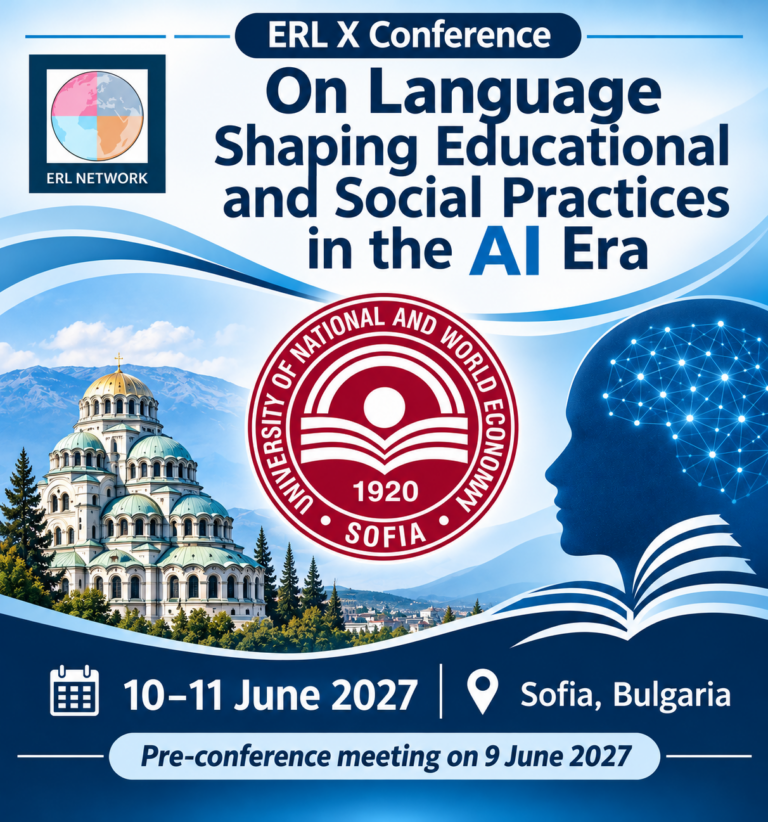
Much more than just a conference.
ERL JOURNAL: VOLUME
2027-1
STAY WITH US
Please note that the ERL conference welcomes various form of contributions: in accordance with the word, we meet to confer not only on conclusions drawn from research, but also to discuss concepts, try out methods, and share ideas. Accordingly, your presentation does not need to be strictly empirical, but it can focus on theory instead. Alternatively, you can also outline a joint project idea or attend for your own workshop slot – as long as it relates to the theme of the ERL Conference.

MORE INFORMATION COMING IN DUE COURSE:
10 THINGS THAT DISTINGUISH ERL CONFERENCES
Distinctive feature No 1: INTELLECTUAL CONTINUITY. ERL Conferences follow a carefully developed thematic sequence called the ERL Trajectory. Each conference contributes to a larger research agenda rather than treating its topic as an isolated subject. The trajectory connects: on the individual level – language and affect/beliefslanguage/activity/thinking, and on the contextual level – language and schooling/culture, methodology and personality. This gives the conferences continuity, cumulative intellectual value and a recognisable identity.
Distinctive feature No 2: INTERDISCIPLINARY OPENNESS. ERL Conferences bring together perspectives from: linguistics and applied linguistics, educational sciences and pedagogy, psychology and cognitive sciences, sociology and cultural studies, communication studies and other disciplines. The central question is not simply how languages are learned or taught, but how language participates in human development, knowledge construction, social interaction and education.
Distinctive feature No 3: LANGUAGE-CENTRED EDUCATIONAL PERSPECTIVE. The conferences are grounded in a particular intellectual premise: language is not merely an instrument of education; it is one of the foundations upon which education rests. This perspective encourages participants to reconsider: (a) how language shapes what we believe, (b) how language determines what we do, (c) how we experience language emotionally, (d) how language influences our thinking and understanding of the world. It also invites discussion of the principle that every teacher is, to some extent, a language teacher.
Distinctive feature No 4: CONCEPTUAL OPENNESS. ERL Conferences welcome more than conventional reports of completed empirical studies. They also provide space for: (a) new theoretical concepts and frameworks, (b) preliminary research ideas and hypotheses, (c) critical reflections and alternative interpretations, (d) proposals for future research, (e) interdisciplinary perspectives that have not yet been sufficiently explored. This makes them a place not only for presenting research results but also for developing the intellectual foundations of a research community.
Distinctive feature No 5: BEYOND THE CONFERENCE FORMAT. An ERL Conference is designed to be more than an academic meeting. Its programme can incorporate: (a) workshops and project-oriented sessions, (b) open meetings of the International Association for the Educational Role of Language (ERLA), (c) activities contributing to the ERL Conceptual Bank, (d) other international research and cooperation initiatives, (e) local cultural experiences and opportunities for informal networking.
Distinctive feature No 6: ACADEMIC ECOSYSTEM. ERL Conferences are part of a wider academic ecosystem involving: ERL Network – the conference-organising network, ERLA – the International Association, ERL Journal – the peer-reviewed academic journal, ERL Conceptual Bank – a developing international collection of concepts and approaches. Conference contributions can lead to peer-reviewed publications, new research partnerships and further development of the ERL framework.
Distinctive feature No 7: THEORY-PRACTICE INTEGRATION. ERL Conferences seek to connect abstract conceptual thinking with the realities of educational environments. They encourage dialogue between researchers, university academics, schoolteachers, teacher educators and other educational practitioners. This means that theoretical insights are not treated as ends in themselves, but as potential foundations for: (a) Improving educational practices, (b) rethinking teaching methodologies, (c) understanding teachers’ and learners’ experiences, (d) developing new approaches to language-related educational challenges.
Distinctive feature No 8: INTERNATIONAL COMMUNITY BUILDING. ERL Conferences offer opportunities to establish lasting academic relationships that extend beyond individual events. Their purpose is not limited to exchanging research findings but also includes developing a shared intellectual identity and encouraging long-term cooperation. They facilitate: (a) international research partnerships, (b) cross-institutional and cross-cultural exchange, (c joint publications and research projects, (d) participation in ERL Network and ERLA activities, (e) the involvement of researchers at different stages of their academic careers.
Distinctive feature No 9: HOLISTIC APPROACH TO LANGUAGE AND HUMAN DEVELOPMENT. ERL Conferences approach the educational role of language as a multidimensional phenomenon, recognising that language influences much more than cognitive development or communicative competence. They provide a framework for examining the relationships between language and four complementary dimensions of human development: axiological – values, beliefs, attitudes and identity; affective – emotions, motivation and interpersonal relationships; psychomotor – action, activity and embodied interaction; cognitive – thinking, reasoning, knowledge and understanding. This perspective encourages participants to move beyond fragmented approaches to language and education towards a more comprehensive understanding of the human learner.
Distinctive feature No 10: RESPONSIVENESS TO CONTEMPORARY CHALLENGES. ERL Conferences provide an intellectual space for examining how the role of language changes in response to contemporary developments in education and society. This includes questions concerning: (a) the impact of artificial intelligence on language and communication, (b) the future of human interaction and spoken communication, (c) multilingualism and intercultural understanding, (d) language-related inequalities and educational exclusion, (e) the changing nature of knowledge construction and transmission. Rather than treating language as a static educational resource, ERL Conferences encourage reflection on its evolving functions and responsibilities in a changing world.